<?xml version="1.0" encoding="utf-8"?><feed xmlns="http://www.w3.org/2005/Atom" ><generator uri="https://jekyllrb.com/" version="4.3.1">Jekyll</generator><link href="http://ipta4gw.org/feed.xml" rel="self" type="application/atom+xml" /><link href="http://ipta4gw.org/" rel="alternate" type="text/html" /><updated>2026-03-16T05:00:02-04:00</updated><id>http://ipta4gw.org/feed.xml</id><title type="html">International Pulsar Timing Array</title><subtitle>The International Pulsar Timing Array is a collaboration formed from the four main PTA groups (EPTA, InPTA, NANOGrav, and PPTA) as well as interested researchers from a variety of countries.</subtitle><entry><title type="html">The IPTA’s Search for Nanohertz Gravitational Waves</title><link href="http://ipta4gw.org/news/2023/06/28/IPTA_statement_on_PTA_results.html" rel="alternate" type="text/html" title="The IPTA’s Search for Nanohertz Gravitational Waves" /><published>2023-06-28T16:00:00-04:00</published><updated>2023-06-28T16:00:00-04:00</updated><id>http://ipta4gw.org/news/2023/06/28/IPTA_statement_on_PTA_results</id><content type="html" xml:base="http://ipta4gw.org/news/2023/06/28/IPTA_statement_on_PTA_results.html"><![CDATA[<p>Detection of the radio emission from the astronomical object in 1930+ by Karl Jansky started an era of Radio Astronomy followed by many discoveries enriching our understanding of the Universe we live in. Similarly, we are on the verge of opening a new window (ultra-low frequencies) in Gravitational Wave Astronomy. We are watching the rolling history of scientific discoveries in slow motion.</p>

<p>In the quest to unravel the nature of gravitational waves (GWs) with pulsar timing arrays (PTAs), the International Pulsar Timing Array (IPTA) is a consortium of PTA collaborations. The current IPTA members include the European Pulsar Timing Array (EPTA), the Indian Pulsar Timing Array (InPTA), the North American Nanohertz Observatory for Gravitational Waves (NANOGrav)  and the Parkes Pulsar Timing Array (PPTA) using the largest radio telescopes in Europe, India, United States, Canada and Australia. There are additionally emergent PTAs in China and South Africa. Through the combination of the individual data sets resulting from the PTAs, the IPTA focuses on the search for GWs in the very low-frequency part of their spectrum (in contrast with previous detections of GWs reported by the LIGO, Virgo and KAGRA collaborations).</p>

<p>About two years ago, the IPTA consortium put in place an arrangement to coordinate the efforts of its constituent PTAs for the release of their latest data sets and the results of GW searches. The objective of this agreement, called the 3P+ agreement, was to provide cross-PTA checks and validation while at the same time allowing independent analysis of the respective data sets by each PTA.</p>

<p>After almost a six-month process of such a review, NANOGrav, the PPTA, the Chinese Pulsar Timing Array (CPTA), and the EPTA, along with the InPTA, are releasing new results regarding their ongoing search for low-frequency GWs on June 29, 2023. These results from independent data and analyses from CPTA, EPTA+InPTA, NANOGrav, and PPTA represent a significant milestone in the search for gravitational waves.</p>

<p>We use ultra-stable millisecond pulsars as Galactic-scale gravitational wave detectors. Monitoring pulsars for over a decade has finally paid off: long-term radio observations, advanced technology, and sophisticated data analysis techniques led to the result reported today around the globe.</p>

<p>The four constituent PTAs of the IPTA are now combining their latest data with the data from a pulsar timing experiment using the MeerKAT Telescope in South Africa, MeerTime, to form the most sensitive data set under the auspices of the IPTA. The cross-PTA platform provided by the IPTA enables scientists from across the globe to combine their talents in this search, which is likely to open a new window to the Universe.</p>

<p>These data are promised to be the most sensitive and hopefully will confirm the nature of the observed signal as gravitational waves. A long road is still ahead of us to understand the source of these GWs: do we observe a signal from supermassive black hole binaries or a signal from the early Universe? We are entering an era of great discoveries. The future is bright in gravitational waves.</p>]]></content><author><name></name></author><category term="news" /><category term="dr3" /><category term="press" /><category term="background" /><category term="gw" /><summary type="html"><![CDATA[Detection of the radio emission from the astronomical object in 1930+ by Karl Jansky started an era of Radio Astronomy followed by many discoveries enriching our understanding of the Universe we live in. Similarly, we are on the verge of opening a new window (ultra-low frequencies) in Gravitational Wave Astronomy. We are watching the rolling history of scientific discoveries in slow motion.]]></summary></entry><entry><title type="html">There will be a meeting in Australia this summer.</title><link href="http://ipta4gw.org/news/2023/02/10/there-will-be-a-meeting-in-australia-this-summer.html" rel="alternate" type="text/html" title="There will be a meeting in Australia this summer." /><published>2023-02-10T18:55:12-05:00</published><updated>2023-02-10T18:55:12-05:00</updated><id>http://ipta4gw.org/news/2023/02/10/there-will-be-a-meeting-in-australia-this-summer</id><content type="html" xml:base="http://ipta4gw.org/news/2023/02/10/there-will-be-a-meeting-in-australia-this-summer.html"><![CDATA[<p>This page exists primarily to serve as a test for the new editing capabilities.</p>

<p>The <a href="https://ipta4gw.org/meetings/">Meetings</a> page has more info about the meeting.</p>]]></content><author><name></name></author><category term="news" /><summary type="html"><![CDATA[This page exists primarily to serve as a test for the new editing capabilities.]]></summary></entry><entry><title type="html">World-wide Radio Telescope Network Strengthens Evidence for Signal that May Hint at Ultra-Low Frequency Gravitational Waves</title><link href="http://ipta4gw.org/news/2022/01/12/IPTA_DR2_GW_Background.html" rel="alternate" type="text/html" title="World-wide Radio Telescope Network Strengthens Evidence for Signal that May Hint at Ultra-Low Frequency Gravitational Waves" /><published>2022-01-12T00:00:00-05:00</published><updated>2022-01-12T00:00:00-05:00</updated><id>http://ipta4gw.org/news/2022/01/12/IPTA_DR2_GW_Background</id><content type="html" xml:base="http://ipta4gw.org/news/2022/01/12/IPTA_DR2_GW_Background.html"><![CDATA[<p>An international team of astronomers has announced the results of a comprehensive search for a background of low-frequency gravitational waves (GWs). These light-year-scale ripples, a consequence of general relativity, permeate all of spacetime and could originate from mergers of the most massive black holes in the Universe or from events occurring soon after the formation of the Universe in the Big Bang.</p>

<p>The International Pulsar Timing Array (IPTA), which joins the work of several astrophysics collaborations from around the world, recently completed its search for GWs in their most recent official data release, known as Data Release 2 (DR2). This data set consists of precision timing data from 65 millisecond pulsars – stellar remnants which spin hundreds of times per second, sweeping narrow beams of radio waves that appear as pulses due to the spinning – combined from independent data sets of the European Pulsar Timing Array (EPTA), the North American Nanohertz Observatory for Gravitational Waves (NANOGrav), and the Parkes Pulsar Timing Array in Australia (PPTA), the three founding members of the IPTA.</p>

<figure class="">
  <img src="/assets/img/ipta_dr2_pr.png" alt="Artist Conception for GW Background and Pulsar Timing Array Experiment" /><figcaption>
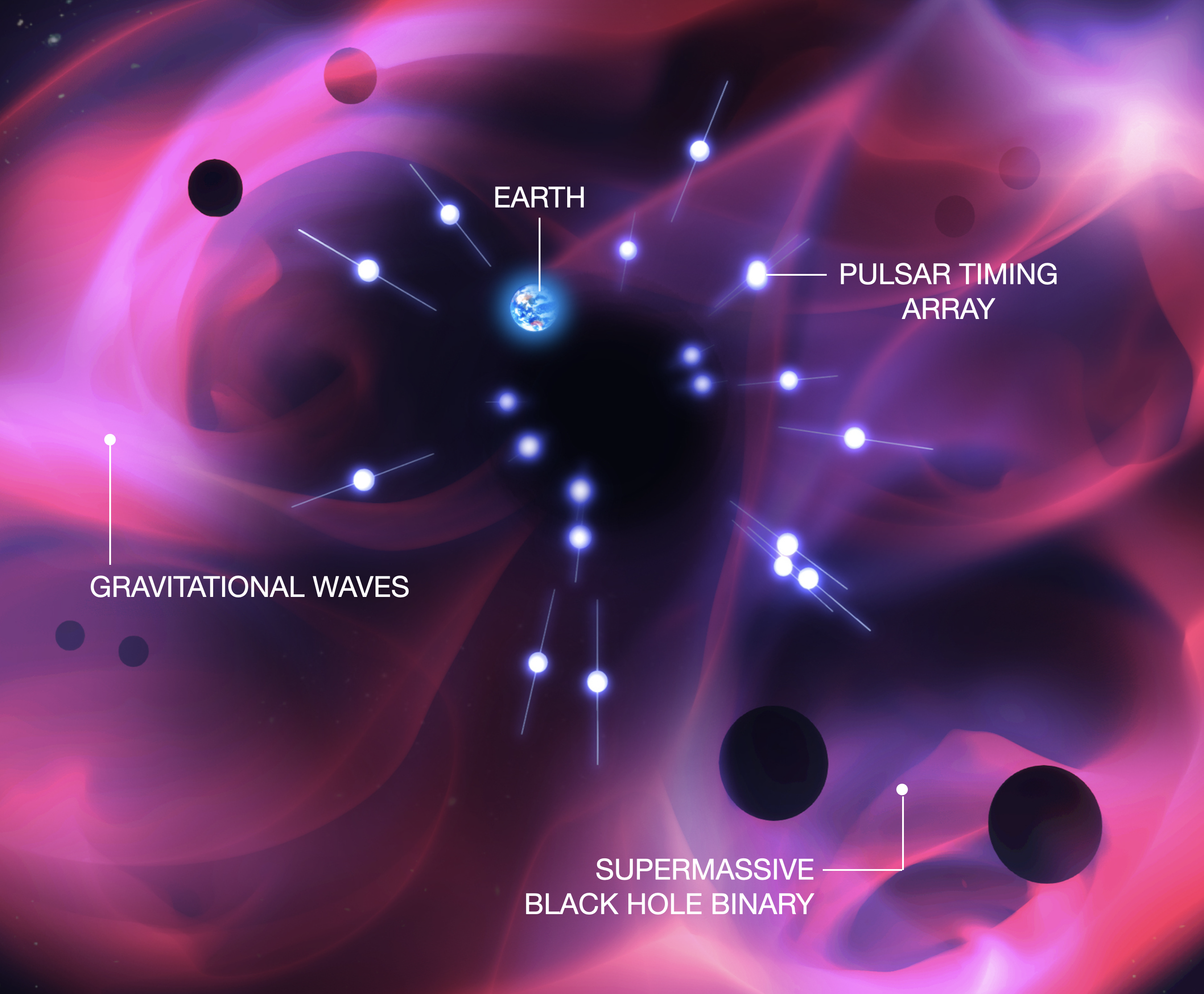
      Artist’s impression of the IPTA experiment – An array of pulsars around the Earth embedded in a gravitational wave background from supermassive black hole binaries. The signals from the pulsars measured with a network of global radio telescopes are affected by the gravitational waves propagating through spacetime, allowing astronomers to study the origin of the background. Photo Credit: Andreas Freise

    </figcaption></figure>

<p>This search includes an extensive comparison between individual data sets from the large regional scientific collaborations and the combined data set. The GW search of the IPTA DR2 has revealed strong evidence for a low-frequency signal detected by many of the pulsars in the combined data. The characteristics of this common-among-pulsars signal are in broad agreement with those expected from a GW “background” (GWB). This background is formed by many different overlapping GW signals emitted from the cosmic population of supermassive binary black holes (i.e., two supermassive black holes orbiting each other and eventually merging), analogous to background noise from the many overlapping voices in a crowded hall. This result further strengthens the gradual emergence of similar signals that have been found in the individual data sets of the participating collaborations over the past few years.</p>

<p>“This is a very exciting signal! Although we do not have definitive evidence yet, we may be beginning to detect a background of gravitational waves,” says Dr. Siyuan Chen, a member of the EPTA and NANOGrav, and the leader of the IPTA DR2 search and publication. Dr. Boris Goncharov from the PPTA cautions on the possible interpretations of such common signals: “We are also looking into what else this signal could be. For example, perhaps it could result from noise that is present in individual pulsars’ data that may have been improperly modeled in our analyses.”</p>

<p>To identify the GWB as the origin of the low-frequency signal, the IPTA must also detect spatial correlations between pulsars; this means that each pair of pulsars must respond in a very particular way to the GWs, depending on their separation on the sky. These signature correlations between pulsar pairs are the “smoking gun” for a GWB detection – without them, it is difficult to prove that some other process is not responsible for the signal. Intriguingly, the first indication of a GWB would be a common signal like that seen in the IPTA DR2. Whether or not this spectrally similar low-frequency signal is correlated between pulsars in accordance with the theoretical predictions for a gravitational-wave background will be resolved with further data collection, expanded arrays of monitored pulsars, and continued searches of the resulting longer and larger data sets.</p>

<p>Consistent signals like the one recovered with the IPTA analysis have also been published in individual data sets more recent than those used in the IPTA DR2, from each of the three founding collaborations. The IPTA DR2 analysis demonstrates the power of the international combination giving strong evidence for a GWB compared to the marginal or absent evidences from the constituent data sets. Additionally, new data from the MeerKAT telescope and from the Indian Pulsar Timing Array (InPTA), the newest member of the IPTA, will further expand future data sets. “The first hint of a GWB would be a signal like that seen in the IPTA DR2. Then, with more data, the signal will become more significant and will show spatial correlations, at which point we will know it is a GWB. We are very much looking forward to contributing several years of new data to the IPTA for the first time, to help achieve a GWB detection,” says Dr. Bhal Chandra Joshi, a member of the InPTA.</p>

<p>Given the latest published results from the individual groups who now all can clearly recover the common signal, the IPTA is optimistic for what can be achieved once these are combined into the IPTA Data Release 3. Work is already ongoing on this new data release, which at a minimum will include the latest data sets from the four constituent PTAs of the IPTA; the GWB analysis of DR3 is expected to be completed within the next few years. Dr. Maura McLaughlin of the NANOGrav collaboration says, “If the signal we are currently seeing is the first hint of a GWB, then based on our simulations, it is possible we will have more definite measurements of the spatial correlations necessary to conclusively identify the origin of the common signal in the near future.”</p>]]></content><author><name></name></author><category term="news" /><category term="dr2" /><category term="press" /><category term="background" /><category term="gw" /><summary type="html"><![CDATA[An international team of astronomers has announced the results of a comprehensive search for a background of low-frequency gravitational waves (GWs). These light-year-scale ripples, a consequence of general relativity, permeate all of spacetime and could originate from mergers of the most massive black holes in the Universe or from events occurring soon after the formation of the Universe in the Big Bang.]]></summary></entry><entry><title type="html">IPTA Statement on the DR2 Press Release</title><link href="http://ipta4gw.org/news/2022/01/12/IPTA_Statement_on_GW_Background.html" rel="alternate" type="text/html" title="IPTA Statement on the DR2 Press Release" /><published>2022-01-12T00:00:00-05:00</published><updated>2022-01-12T00:00:00-05:00</updated><id>http://ipta4gw.org/news/2022/01/12/IPTA_Statement_on_GW_Background</id><content type="html" xml:base="http://ipta4gw.org/news/2022/01/12/IPTA_Statement_on_GW_Background.html"><![CDATA[<p>The International Pulsar Timing Array (IPTA) recently completed its analysis of their most recent official data release, known as Data Release 2. This consisted of precision timing data from 65 millisecond pulsars, combined from separate datasets of the European Pulsar Timing Array (EPTA), the North American Nanohertz-frequency Gravitational Waves Observatory (NANOGrav), and the  Parkes Pulsar Timing Array (PPTA).  It found very strong evidence for a spectrally similar low-frequency signal in many of the pulsars. The characteristics of this signal are in broad agreement with spectral models of an astrophysical gravitational-wave (GW)  background from a population of supermassive binary black holes. However, no evidence has been found for the distinctive pattern of cross-correlations between pulsars that would identify GWs as the origin of this low-frequency signal. These results, synthesized from older PTA datasets, corroborate what has been more recently found by NANOGrav, PPTA, and EPTA in their most recent data releases. Whether or not this spectrally similar low-frequency signal is correlated between pulsars in accordance with a GW background is something that will be resolved with further data collection, expanded arrays of monitored pulsars, and continued analyses. By combining the data and efforts of PTA collaborations, the IPTA can naturally achieve these aims, and is currently working to answer this question.</p>

<p>Below, we include links to the recently published results from the three individual PTAs’ data sets:</p>

<ul>
  <li><em>The NANOGrav 12.5-year Data Set: Search For An Isotropic Stochastic Gravitational-Wave Background</em>, The Astrophysical Journal Letters, Volume 905, Number 2 (2020), <a href="https://ui.adsabs.harvard.edu/link_gateway/2020ApJ...905L..34A/doi:10.3847/2041-8213/abd401">arXiv:2009.0449</a></li>
  <li><em>On the Evidence for a Common-spectrum Process in the Search for the Nanohertz Gravitational-wave Background with the Parkes Pulsar Timing Array</em>, The Astrophysical Journal Letters, Volume 917, Issue 2 (2021), <a href="https://ui.adsabs.harvard.edu/link_gateway/2021ApJ...917L..19G/doi:10.3847/2041-8213/ac17f4">arXiv:2107.12112</a></li>
  <li><em>Common-red-signal analysis with 24-yr high-precision timing of the European Pulsar Timing Array: inferences in the stochastic gravitational-wave background search</em>, Monthly Notices of the Royal Astronomical Society, Volume 508, Issue 4 (2021), <a href="https://ui.adsabs.harvard.edu/link_gateway/2021MNRAS.508.4970C/doi:10.1093/mnras/stab2833">arXiv:2110.13184</a></li>
</ul>]]></content><author><name></name></author><category term="news" /><category term="dr2" /><category term="press" /><category term="background" /><category term="gw" /><summary type="html"><![CDATA[The International Pulsar Timing Array (IPTA) recently completed its analysis of their most recent official data release, known as Data Release 2. This consisted of precision timing data from 65 millisecond pulsars, combined from separate datasets of the European Pulsar Timing Array (EPTA), the North American Nanohertz-frequency Gravitational Waves Observatory (NANOGrav), and the Parkes Pulsar Timing Array (PPTA). It found very strong evidence for a spectrally similar low-frequency signal in many of the pulsars. The characteristics of this signal are in broad agreement with spectral models of an astrophysical gravitational-wave (GW) background from a population of supermassive binary black holes. However, no evidence has been found for the distinctive pattern of cross-correlations between pulsars that would identify GWs as the origin of this low-frequency signal. These results, synthesized from older PTA datasets, corroborate what has been more recently found by NANOGrav, PPTA, and EPTA in their most recent data releases. Whether or not this spectrally similar low-frequency signal is correlated between pulsars in accordance with a GW background is something that will be resolved with further data collection, expanded arrays of monitored pulsars, and continued analyses. By combining the data and efforts of PTA collaborations, the IPTA can naturally achieve these aims, and is currently working to answer this question.]]></summary></entry><entry><title type="html">IPTA Mock Data Challenge 2 is Open</title><link href="http://ipta4gw.org/news/2018/10/24/Mock-Data-Challenge-II.html" rel="alternate" type="text/html" title="IPTA Mock Data Challenge 2 is Open" /><published>2018-10-24T00:00:00-04:00</published><updated>2018-10-24T00:00:00-04:00</updated><id>http://ipta4gw.org/news/2018/10/24/Mock-Data-Challenge-II</id><content type="html" xml:base="http://ipta4gw.org/news/2018/10/24/Mock-Data-Challenge-II.html"><![CDATA[<p>We have posted a short introduction to PTA science and the current mock data challenge to the <a href="https://arxiv.org/abs/1810.10527">Arxiv</a>. The challenge is being administered through the <a href="https://github.com/ipta/mdc2">IPTA GitHub</a> page. Additional informatino can be found at the website for the <a href="https://ipta.github.io/mock_data_challenge/">MDC</a> and here on the <a href="http://ipta4gw.org/mdc">IPTA webpage</a>.</p>]]></content><author><name></name></author><category term="news" /><category term="mdc" /><category term="data" /><summary type="html"><![CDATA[We have posted a short introduction to PTA science and the current mock data challenge to the Arxiv. The challenge is being administered through the IPTA GitHub page. Additional informatino can be found at the website for the MDC and here on the IPTA webpage.]]></summary></entry></feed>